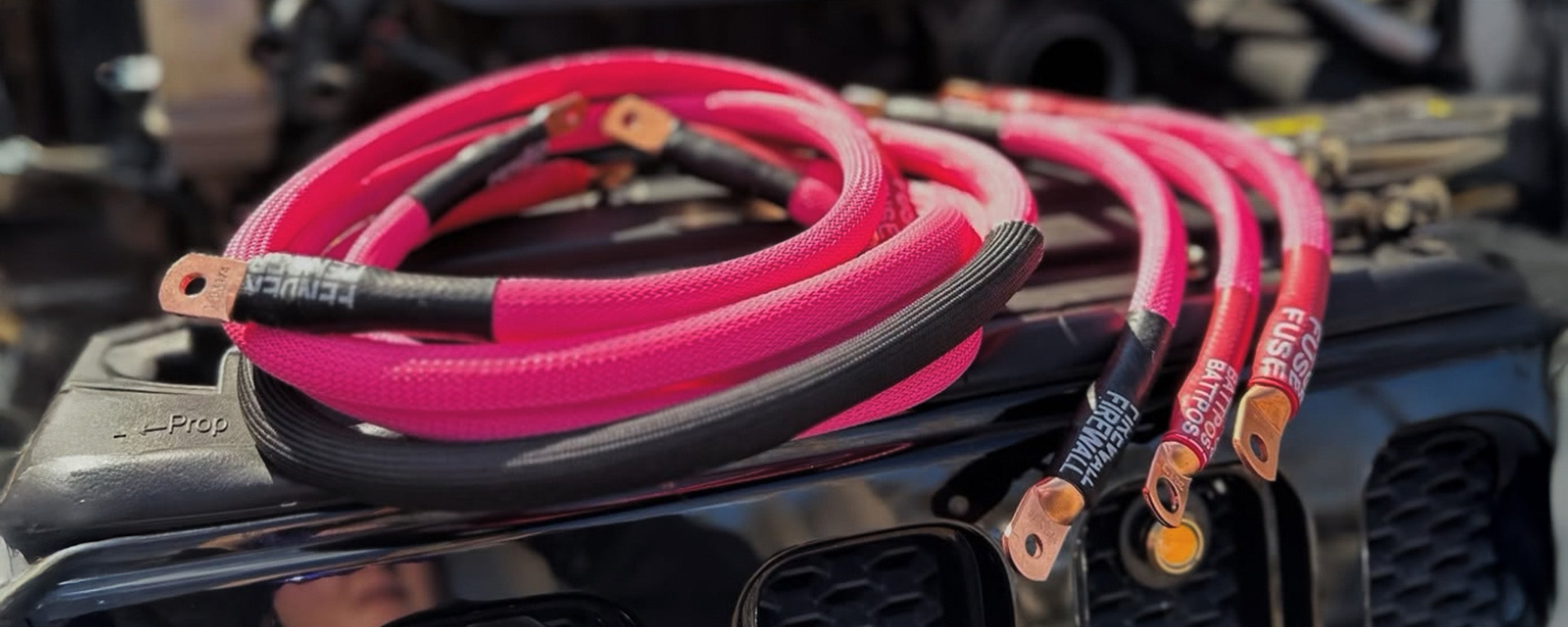

Big 3 vs Big 7 Battery Cable Upgrade: What's the Difference

If you've spent any time on car audio or off-road forums, you've seen the advice: “do the Big 3.” It's one of the most recommended electrical upgrades for any vehicle — and for good reason. But the Big 3 only addresses three of the seven weak links in your vehicle's charging and starting system. That's why we build the Big 7.
This guide explains exactly what each upgrade includes, what the Big 3 leaves out, and how to decide which one your build actually needs.
What Is the Big 3 Upgrade?
The Big 3 upgrade (sometimes called the Big 4) means replacing or augmenting the three highest-current cables in your vehicle's electrical system with larger-gauge wire:
- Alternator to battery positive — carries charging current from the alternator to the battery.
- Battery negative to chassis ground — the main ground return path.
- Engine block to chassis ground — grounds the engine (where the alternator and starter live) to the body/chassis.
The factory versions of these cables were sized for the vehicle as it left the assembly line — a stock alternator, a stock stereo, no winch, no light bar. Upgrading them to 4, 2, or 1/0 gauge reduces resistance, which means less voltage drop, brighter headlights, stronger amplifier output, and a charging system that can actually deliver the amperage a high-output alternator produces. A Universal Big 3 Battery Upgrade Kit can help provide the upgraded wiring needed for these electrical demands. It's the standard first step in car audio builds, and it's why “big 3 car audio” is one of the most searched wiring upgrades.
What the Big 3 Leaves Out
Here's the problem: your charging and starting circuit has more than three cables, and on a 20- or 30-year-old vehicle, every one of them has the same corroded, undersized factory wire. After a Big 3, you still have:
- Battery positive to starter — the highest-current cable in the entire vehicle (cranking loads can exceed anything your stereo pulls).
- Battery to fuse/relay box — feeds every accessory circuit in the vehicle.
- Engine block to frame ground — a second ground path most kits ignore entirely.
- Corroded factory battery terminals — 30-year-old clamps that no amount of new cable can fix.
Upgrading three cables and leaving the rest is like putting three new tires on a car. The remaining factory cables are still the resistance bottleneck — especially the starter cable on older Jeeps and diesel trucks, where hard starts and slow cranking are usually a cable problem, not a battery problem.
What Is the Big 7 Upgrade?
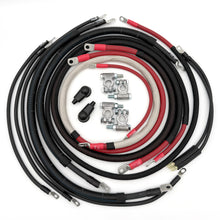
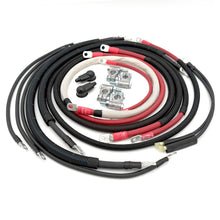
The Big 7 Complete Kit replaces every cable in the charging and starting circuit — all seven connections — plus the hardware to install it properly:
| # | Cable / Component | What it fixes |
|---|---|---|
| 1 | Alternator → Battery (+) | Charging voltage drop |
| 2 | Battery (+) → Starter | Slow cranking, hard starts |
| 3 | Battery (−) → Frame ground | Main ground return |
| 4 | Engine block → Body ground | Accessory/ECU ground noise |
| 5 | Engine block → Frame ground | Complete ground loop |
| 6 | Battery → Fuse/relay box | Weak accessory power |
| 7 | Inline MEGA fuse + holder | Circuit protection the factory never included |
| + | Military-style battery terminals | Replaces corroded factory clamps; every cable end labeled |
Every Big 7 kit is built with 100% fine-strand SAE J1127 OFC copper (never copper-clad aluminum), sealed with MIL-spec adhesive-lined heat shrink, and cut to length for your specific vehicle — so a TJ kit fits a TJ without measuring, cutting, or crimping anything.
Big 3 vs Big 7: Side-by-Side
| Big 3 Upgrade | Big 7 Complete Kit | |
|---|---|---|
| Alternator → Battery (+) | ✓ Yes | ✓ Yes |
| Battery (−) → Chassis ground | ✓ Yes | ✓ Yes |
| Engine → Chassis ground | ✓ Yes | ✓ Yes |
| Battery (+) → Starter | ✗ No | ✓ Yes |
| Battery → Fuse/relay box | ✗ No | ✓ Yes |
| Engine → Frame ground | ✗ No | ✓ Yes |
| Inline fuse protection | ✗ No | ✓ Yes |
| New battery terminals | ✗ No | ✓ Yes |
| Vehicle-specific, labeled ends | Rarely | ✓ Yes |
Which One Do You Need?
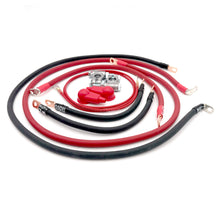
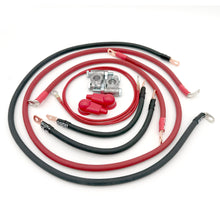
Choose the Big 3 if: your factory cables are in good shape, you're on a newer vehicle, and your only goal is supporting a bigger amplifier. Our Universal Big 3 kit covers exactly this.
Choose the Big 7 if: you're on an older platform (Jeep XJ/TJ/YJ/JK, Cummins, Power Stroke), you're chasing electrical gremlins, adding a winch, lights, or high-output alternator — or you simply want to do the job once. If the starter cable and grounds are 25 years old, replacing only three cables leaves the worst offenders in place.
Frequently Asked Questions
Is the Big 3 upgrade worth it?
Yes — it's the highest-impact wiring upgrade per dollar. But on older vehicles, the Big 7 fixes the failure points the Big 3 skips, for one predictable price.
What gauge should I use?
2GA is our most popular all-around choice (up to ~180A). See our full wire size guide for the 4GA vs 2GA vs 1/0 decision.
Do I need to cut or crimp anything?
No — Big 7 kits arrive cut to length for your vehicle with every end labeled and terminated.
Find the Big 7 kit for your vehicle →
Just want to support a bigger amp on a newer vehicle? The Universal Big 3 kit covers exactly that. Not sure on gauge? Read What Size Battery Cable Do I Need?